




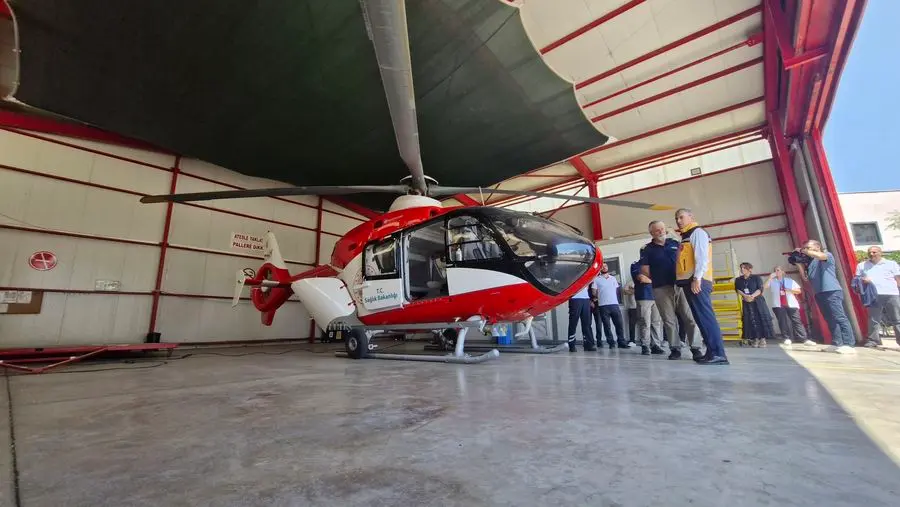
A Ministry of Health air ambulance helicopter based in Diyarbakır transported 128 patients in the first seven months of 2026, including 14 newborns, while also serving several neighboring provinces.
A Ministry of Health air ambulance helicopter based in Diyarbakır, southeastern Türkiye, transported 128 patients and injured people during the first seven months of 2026, including 14 newborns. Diyarbakır Provincial Health Director Dr. Emre Asiltürk described the aircraft as an “intensive care unit in the air,” highlighting its role in rapid transfers for critically ill patients across Diyarbakır and neighboring provinces.
A Ministry of Health air ambulance helicopter based in Diyarbakır transported 128 patients and injured people to healthcare facilities during the first seven months of 2026, including 14 newborns, according to Diyarbakır Provincial Health Director Dr. Emre Asiltürk.
The helicopter serves not only Diyarbakır but also parts of several neighboring provinces, providing rapid medical transportation for patients who require urgent or advanced care.
Asiltürk described the helicopter as an “intensive care unit in the air,” referring to its medical capabilities for transporting critically ill patients.
“We can describe our ambulance helicopters as our ‘intensive care units in the air,’” Asiltürk said. “They serve a wide area, not only Diyarbakır. Along with Diyarbakır, we serve certain parts of the neighboring provinces of Siirt, Şırnak, Mardin, Şanlıurfa, Elazığ and Adıyaman.”
128 patients in seven months
According to Asiltürk, the air ambulance helicopter assisted approximately 128 patients and injured people during the first seven months of 2026.
Fourteen of those transported were newborns, a patient group for whom rapid access to specialized medical care can be particularly important.
“Our ambulance helicopter served approximately 128 patients in the first seven months of this year,” Asiltürk said. “Among them, one of our most important groups is newborns. During this period, we also served 14 newborns.”
Patients with serious burns are another important group transported by the service, according to Asiltürk.
The helicopter can also be deployed in severe trauma cases and other emergencies where delays in reaching an appropriate medical center could affect treatment.
Critical cases where time matters
One of the main advantages of an air ambulance helicopter is its ability to reduce transportation time when transferring critically ill or injured patients over long distances.
It can also provide access to some locations that may be difficult or time-consuming to reach by road.
Asiltürk cited major traffic accidents and severe blood loss as examples of emergencies in which rapid transportation can become particularly important.
“There may be a traffic accident, for example, with severe blood loss,” he said. “Transport by road could take a long time, or the patient could be stranded in a very remote location. With the ambulance helicopter, we can provide rapid transportation.”
Air ambulance missions remain dependent on factors including weather conditions, flight safety, suitable landing areas and the patient’s clinical needs.
Service extends beyond Diyarbakır
The Diyarbakır-based air ambulance helicopter operates as a regional service rather than being restricted to the provincial boundaries.
According to Asiltürk, it can serve parts of Siirt, Şırnak, Mardin, Şanlıurfa, Elazığ and Adıyaman, in addition to Diyarbakır.
The regional model allows patients requiring advanced treatment to be transferred more rapidly to appropriate medical centers when conditions permit.
Asiltürk said the helicopter can operate within a flight range of approximately two hours and 15 minutes under suitable weather and operational conditions.
“As long as flight and weather conditions permit, it can fly regardless of distance within its operating range,” he said. “We can fly from here as far as Kayseri. Round trips can be carried out anywhere within a flight distance of two hours and 15 minutes.”
An ‘intensive care unit in the air’
Asiltürk’s description of the helicopter as an “intensive care unit in the air” refers to the medical equipment and clinical support available during the transportation of critically ill patients.
Air ambulances carry equipment designed to allow medical teams to monitor patients’ vital signs and provide necessary emergency interventions during transport.
This capability can be particularly important for newborns, patients with major trauma or severe burns, and people who urgently need treatment at a specialized medical center.
The phrase “intensive care unit in the air,” however, is a descriptive comparison rather than a separate official classification of a healthcare facility.
Regional emergency care network
The helicopter forms part of a broader emergency medical transportation network serving Diyarbakır and surrounding provinces.
Regional coordination is particularly important when a patient requires treatment that is unavailable at the nearest healthcare facility and must be transferred to a specialist center.
Asiltürk has also emphasized coordination between provinces in managing patient transfers and referral pathways.
Official figures from Diyarbakır authorities show that the province’s wider emergency healthcare capacity has expanded, with the number of emergency medical service stations reaching 79 and the ambulance fleet increasing to 121 vehicles.
The regional air ambulance helicopter adds an additional transportation option for cases in which speed, distance or geographical conditions make road transfer less suitable.
Why It Matters
An air ambulance helicopter can play a critical role in transferring patients to specialized healthcare facilities when long distances or difficult terrain make road transportation slower. Diyarbakır’s helicopter also serves neighboring provinces, strengthening regional emergency care capacity. For newborns, severe trauma patients and people with serious burns, timely access to an appropriate treatment center can be an important part of emergency medical care.
Frequently Asked Questions
How many patients did the Diyarbakır air ambulance helicopter transport?
According to Diyarbakır Provincial Health Director Dr. Emre Asiltürk, the helicopter served approximately 128 patients and injured people during the first seven months of 2026. Fourteen of those patients were newborns.
Which provinces does the Diyarbakır air ambulance helicopter serve?
In addition to Diyarbakır, the helicopter can serve parts of Siirt, Şırnak, Mardin, Şanlıurfa, Elazığ and Adıyaman. Individual missions depend on medical need, weather conditions and operational requirements.
Is an air ambulance helicopter really an intensive care unit?
The phrase “intensive care unit in the air” is a description used by Diyarbakır Provincial Health Director Emre Asiltürk to highlight the aircraft’s medical capabilities. Air ambulances carry equipment that allows medical teams to monitor and support critically ill patients during transportation.
What types of patients are transported by air ambulance helicopters?
Air ambulances can be used for patients requiring urgent transfer to appropriate healthcare facilities. Newborns, patients with severe trauma or burns, and other time-critical cases may be considered for helicopter transportation depending on their clinical condition.
Source: Ministry of Health, Diyarbakır Provincial Health Directorate, Diyarbakır Governor’s Office
This content has been prepared solely for news and general information purposes. The information provided herein is not intended for diagnosis or treatment. Please consult your doctor or a qualified healthcare provider regarding decisions concerning your health. Our website is not liable for any direct or indirect consequences arising from the use of the published information.